The ODR Cycle
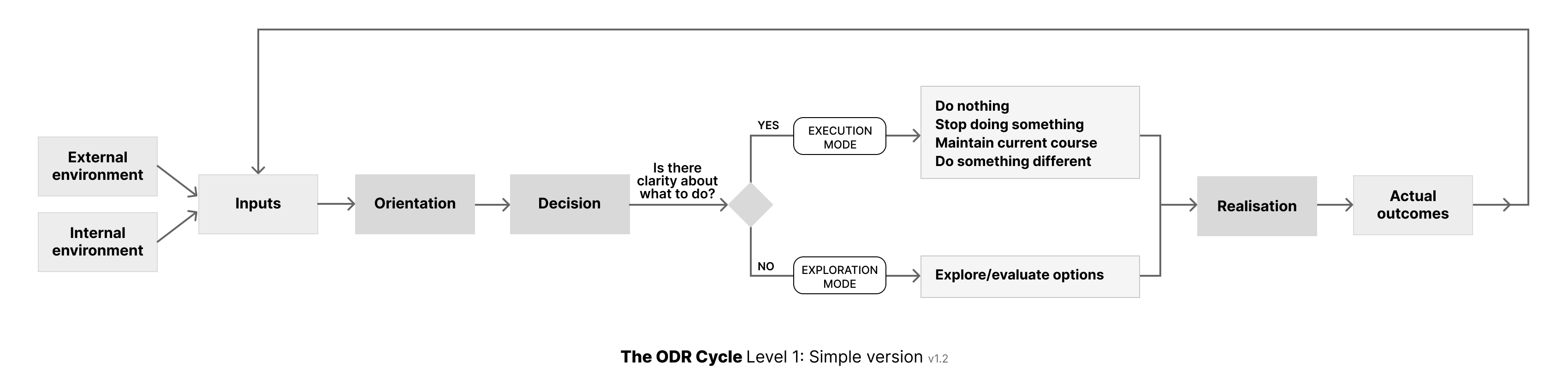
The ODR (Orientation-Decision-Realisation) cycle aims to help people understand the decision-making cycle that all individuals, groups and organisations go through continually – and help identify where there are issues that need addressing.
The aim of Level 1 is to introduce the main ideas behind the cycle without overwhelming people who are new to the cycle with excessive information.
The cycle
Orientation
We are always orienting to the world, based on what is happening in the world (including the outcome of our previous actions), what we want to achieve and how big the gap is between where we are and where we want to be.
Decision
As a result of our orientation, we can start to consider what options we have before we come to a decision. There are always five different types of decisions we can make:
- we can decide to do nothing
- we can decide to stop doing something
- we can decide to maintain our current course of action
- we can decide to do something different
- we can decide to explore options.
The first four can be considered part of our execution mode of action. When we have clarity about what we want to do, then we just need to decide to do it.
The last one, Explore/evaluate options, involves our exploration mode of action, when we don’t have clarity about what we want to do so we need to explore new possibilities.
Realisation
Once a decision has been made, it needs to be implemented.
Outcomes
Of course, decisions always result in outcomes: positive, negative or inconclusive. And these go back to orientation to re-start the cycle.
The practical uses of the cycle
The cycle may seem simplistic but each point of the cycle can surface potential issues that are stopping you from making good decisions and getting the results that you want.
1. Orientation. The Orientation stage is critical because if you are not orienting adequately to the world, then you’re much less likely to get the outcomes you want. Potential problems include:
- not being clear about what your desired outcomes are. If you don’t have a clear idea of what you want, then you may struggle to make the right decisions
- not understanding the world accurately: you can only orient to the world properly if the frames and models you use to understand the world adequately represent reality. An inadequate understanding of reality can lead to ineffective or wrong decisions being made.
- not having a clear idea of the operational resources you can bring to bear on the world.
2. Decision. Potential problems with the Decision stage include:
- focusing on Execution mode when it’s Exploration mode that’s required. When outcomes aren’t being achieved, it’s easy to get stuck in Execution mode when a completely new approach might be needed
- focusing on Exploration mode when it’s Execution mode that’s required. It can be easy to feel the need to keep exploring out of fear of not having enough information even when it’s clear that getting all the information desired may never happen
- getting stuck with obvious options. It’s easy to start looking for new options but then get stuck in the trap of conventional thinking. Sometimes it’s important to use creative strategies to come up with genuinely new ideas.
3. Realisation. There can be a gap between what’s decided upon and what’s actually implemented:
- sometimes an actor lacks the operational resources needed to implement a decision
- sometimes a decision isn’t converted into the desired action because of poor communication, unclear instructions or organisational friction
- sometimes actors within a system can refuse to enact a decision because of competing interests or misaligned incentives.
Some key points
1. The ODR model is fractal: the same Orientation–Decision–Realisation structure recurs across different time horizons and levels of scale. For an individual, the cycle can relate to a life path, a project, a week or a single conversation. For a company, it can relate to a strategy cycle, a quarterly plan, or the outcome of a sales conversation.
This means that smaller cycles feed into and shape larger cycles, while larger cycles constrain and direct smaller ones.
It also means that smaller sub-systems of larger systems (such as departments in a company) can be pursuing multiple interacting ODR cycles at the same time. One of the key functions of larger systems is to coordinate the ODR cycles of its sub-systems.
2. The different decision options are not mutually exclusive. With complex systems or projects, there will be many decisions needing to be made in tandem and it’s possible that all five decision types will be involved.
3. The ODR cycle has similarities to John Boyd’s OODA (Observation-Orientation-Decision-Action) loop. However, there are also differences. In my model, Observation becomes part of the Orientation stage. I have also opened up the Decision stage to name the different decision types. In addition, I have changed the Action stage to Realisation as Action doesn’t encompass all of the decision types.
A more detailed explanation of the cycle
This is a very basic version of the ODR cycle. It can become a very useful analytical tool by going deeper into the three stages of Orientation, Decision and Realisation. I will be writing a more detailed explanation soon.