Introduction to the Core Outcome Evolution Models
This article provides a brief introduction to the three core models underpinning the Outcome Evolution framework.
1. ODR cycle
The ODR (Orientation-Decision-Realisation) cycle describes a recurring cycle of behaviour which applies across multiple levels of scale, from individuals to organisations and nation states, and across multiple time periods, from minutes to decades.
The cycle starts with Orientation. An actor begins by orienting to both the external world and their internal situation in the context of their desired outcomes. They then use this understanding to make a Decision intended to move them closer to those outcomes — and to put that decision into practice. The Realisation of the decision produces actual outcomes which then need to be understood in the Orientation stage of the next iteration of the cycle.
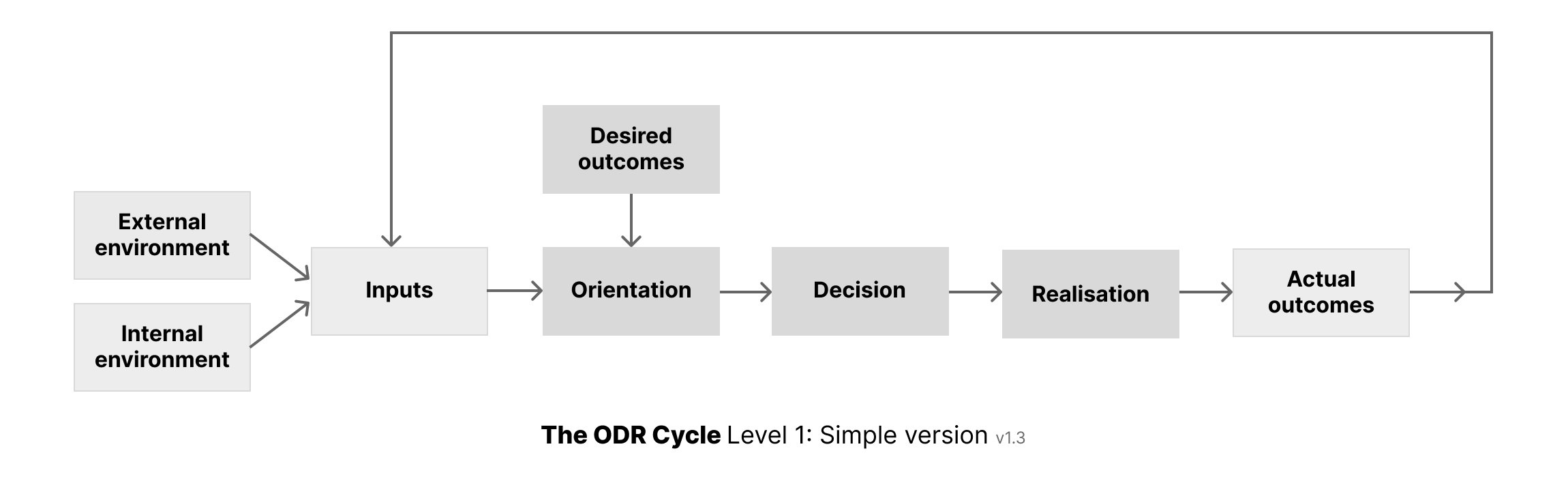
On the surface, it appears to be a simple model. However, each component, as well as the relationships between them, can be examined in significant detail.
2. FMORB model
FMORB is a model of the components that shape how actors think and act. It stands for Frames, Models, Operational Resources and Behaviour.
Frames organise the meaning we assign to different aspects of reality. They shape how we interpret situations, what we value and what we see as appropriate or legitimate behaviour.
Models represent how we believe the world works. They describe the perceived structure of reality and the likely consequences of actions, allowing us to make predictions and decisions.
Operational resources are the capabilities and capacities that allow actors to act in the world. They can include physical and financial assets, skills, knowledge, systems and organisational capacity.
Behaviour is what is actually done in practice, shaped by an actor’s frames, models and operational resources.
The FMORB model is primarily used in the Orientation stage of the ODR cycle. It helps actors understand their own internal situation as well as the capabilities and behaviour of other relevant actors.
3. Evolutionary dynamics model
The evolutionary dynamics model anchors the OE framework in evolutionary thinking.
It explains how outcomes emerge and change over time through the interaction of variation, selection and feedback.
In biological systems, variation arises largely outside the conscious control of the organism and selection takes place in the external environment. Organisms do not choose their own desired outcomes; these are shaped by biological drives and evolutionary pressures.
In human systems—such as individuals, businesses, organisations and nation-states—variation is often a matter of conscious decision. Actors generate and select between alternative courses of action in pursuit of outcomes they themselves define. Selection operates both internally, through decision-making, and externally, through the conditions of the environment.
Selection in human affairs operates through multiple interacting forces. There are:
- reality constraints: the limits imposed by the physical, biological or economic world
- competitive pressures: multiple actors or approaches competing for scarce resources and attention
- rule-based selection: laws, regulations and institutional procedures determining what is permitted or rewarded
- frame pressures: cultural meanings, norms and expectations shaping what is seen as legitimate or desirable
These forces, on their own or in combination, create a selection environment which determines whether strategies and behaviours succeed or fail.
Understanding both the constraints imposed by the selection environment and the opportunities it creates is a critical part of the Orientation stage of the ODR cycle. Actors who understand the dynamics of the selection environment they are operating in are better able to generate viable options, select between them effectively, and align their behaviour with the conditions required for success.
When actors succeed in achieving their outcomes, they often increase their operational resources. This expands their capacity to act and improves their chances of success in subsequent iterations of the ODR cycle.